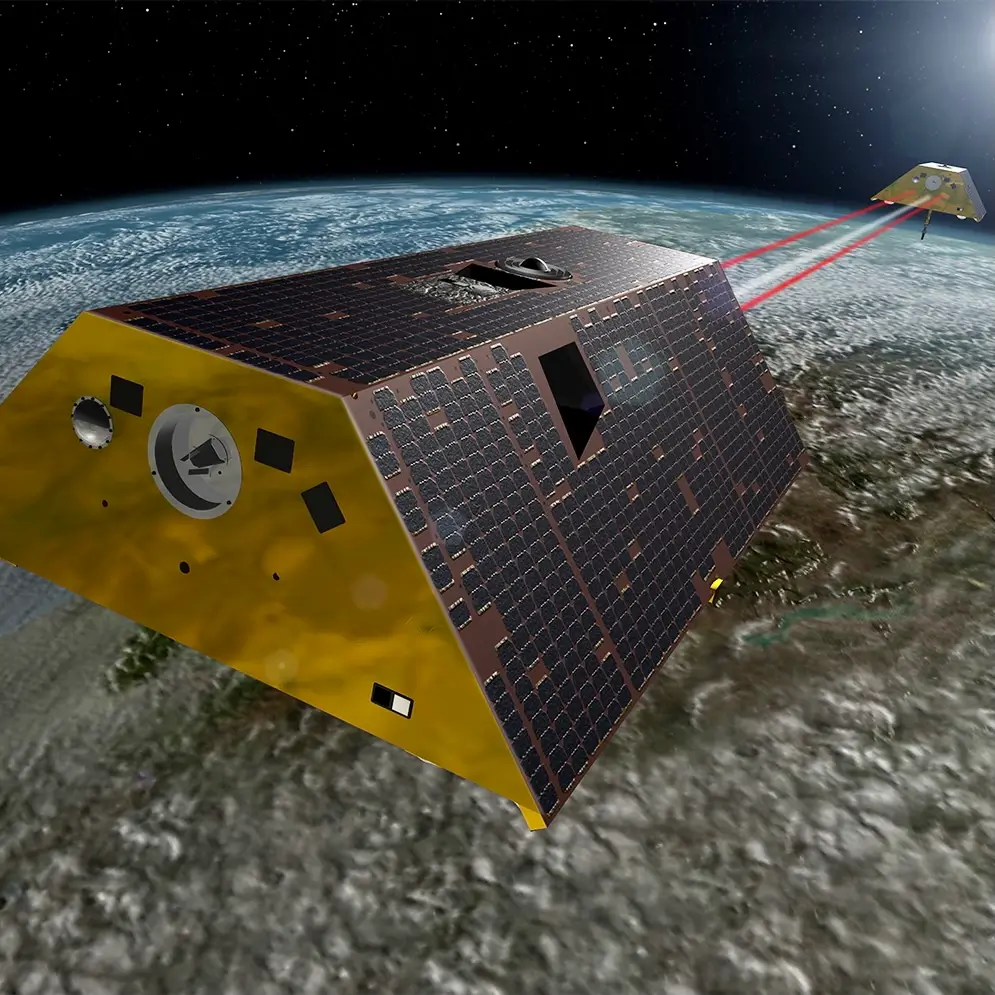
What is LISA?
Optical Truss Interferometer
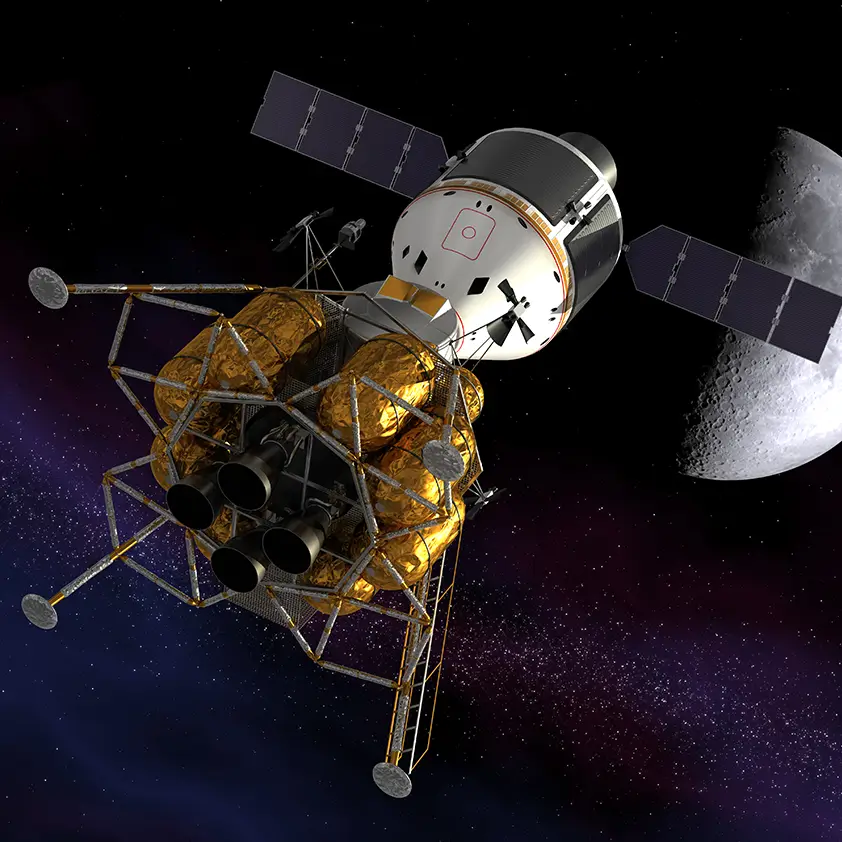
Artistic rendering
of LISA spacecraft
constellation
- The Laser Interferometer Space Antenna (LISA) is a mission led by ESA, in collaboration with NASA and an international consortium of scientists, to create a large-scale space-based gravitational wave observatory.
- The observatory will consist of a constellation of three spacecraft, each separated by 2.5 million kilometers to form an equilateral triangle in their formation.
- One of the main technological goals for LISA is to measure variations in the separation between free falling test masses aboard each spacecraft with a sensitivity of 10 pm/√Hz using interferometric methods.
- The LISA telescopes will relay the laser beams, to and from each spacecraft, that are used to measure the separation between freely falling test masses which are shielded, but untouched by the spacecraft. An incoming gravitational wave will induce perturbations in the separation between each pair of test masses, and these perturbations can then be measured and analyzed to determine the source and origin of the wave.
- A key difference between LISA and ground-based detectors is the ability to measure gravitational waves in a bandwidth from 0.1 mHz to 1 Hz. Detection in this bandwidth has not yet been achieved in gravitational waves and would introduce valuable information about gravitational wave sources and fundamental physics.
Our Work:
Graphical drawing of the truss cavities
mounted onto the LISA telescope structure
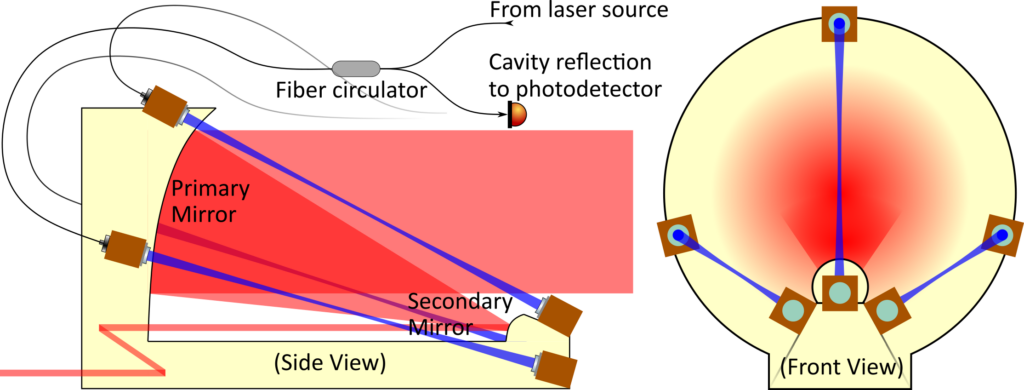
The fiber-injected input stages are attached around the primary mirror, while the return stages are attached around the secondary mirror. The use of three truss cavities allows for the measurement of not only path length variations in the telescope, but also of differential length changes at three separate points around the aperture. These measurements can provide information about wavefront errors coupling into the LISA observation band.
Using a Pound-Drever-Hall (PDH) frequency locking technique, variations in the cavity lengths will change the frequency of the locked laser light. Thus, monitoring the frequency variations in the laser light will in effect monitor length variations in the telescope structure. The frequency variations will be monitored using heterodyne detection by measuring a beat frequency between the laser light from each cavity and a laser that is locked to a stable reference cavity. We have designed and developed first generation OTI prototype cavities, and our current work involves testing the stability performance of these units when mounted onto ultra low expansion (ULE) glass plates and tested with various PDH-based frequency stabilization methods.
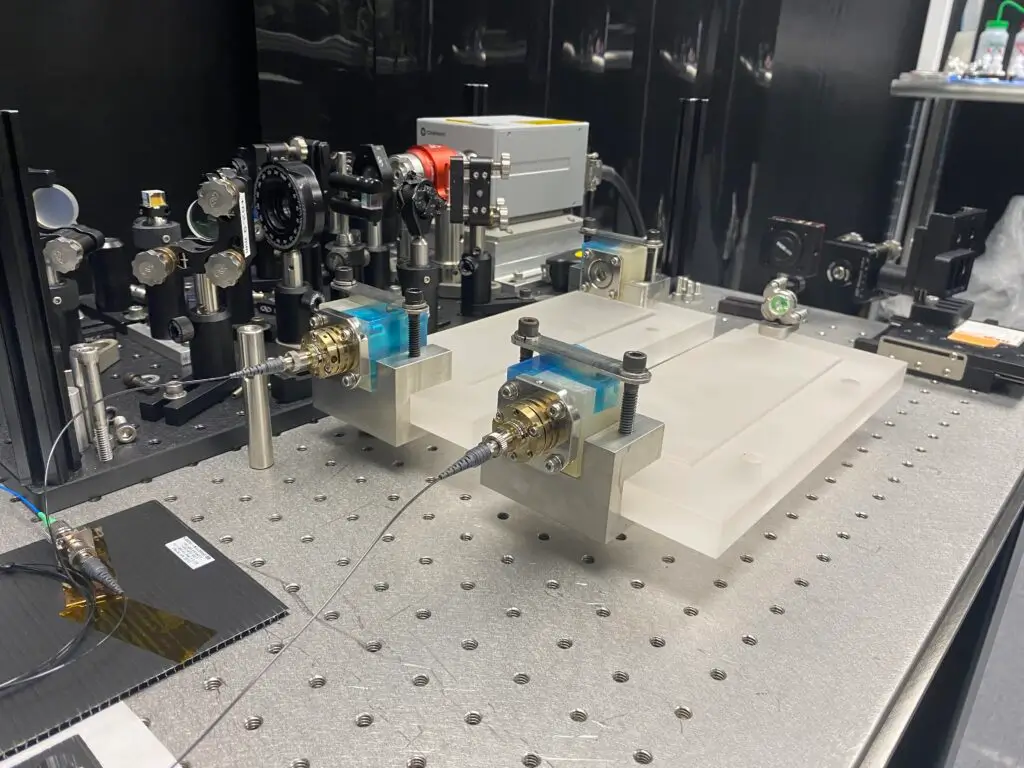
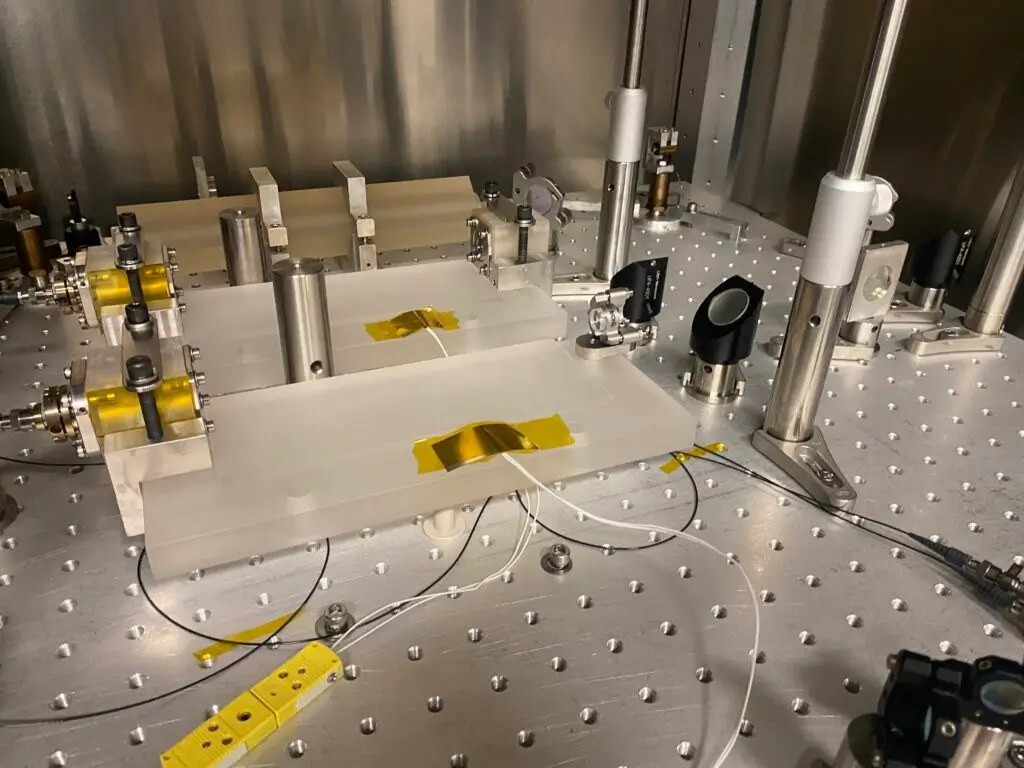
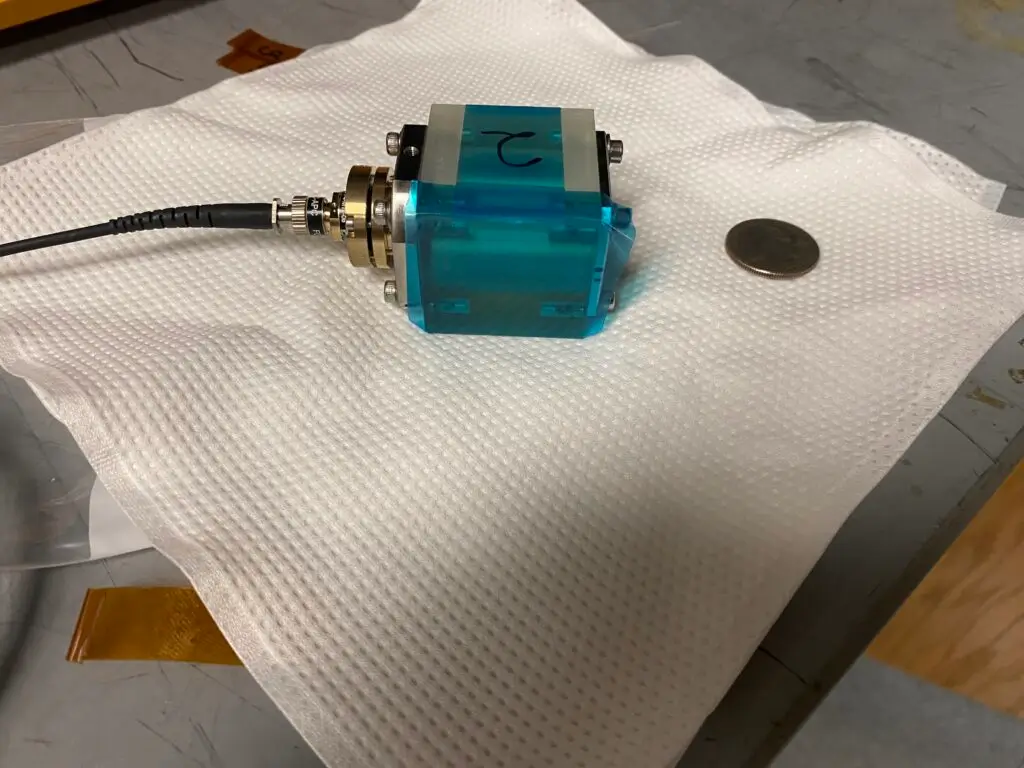
Photos of the prototype OTI input stage and the assembled cavities mounted onto ULE glass plates.
The bottom photo shows the test cavities inside a vacuum chamber optical bench along with a Zerodur reference cavity in the background.
Gravimeter
Compact Sensors for Ligo
A rendering of the sensor
being developed
for use in LIGO
A rendering of the sensor being developed for use in LIGO. There are two fused silica resonators, each with a different resonance in order to increase the bandwidth of the sensor. The acceleration of each resonator is measured by observing the phase difference between two beams of light: one that is reflected off a mirror on the test mass and one that is reflected off a mirror on the frame of the sensor.
- Gravimetry is vital for operations in the Laser Interferometer Gravitational-wave Observatory (LIGO) project.
- In order to detect gravitational waves, LIGO’s interferometers must be able to track the position of a test mass with an accuracy on the order of 10-19 m. However, vibrations coming from outside the interferometer, such as seismic activity and cars driving along the road, will make noise so the LIGO interferometers will not reach this displacement sensitivity.
- With the use of gravimeters, these outside vibrations can be detected and removed from the LIGO systems via active feedback, allowing LIGO researchers to achieve the desired displacement sensitivity.
- The gravimeters employed by LIGO tend to suffer from one or more drawbacks, including being large, expensive, and incompatible with vacuum or cryogenic temperatures.


 1630 E. University Blvd.